California rewrote guard training in 2026: the single-provider rule, the 6-month window, and what to verify before signing a security contract.
California rewrote guard training in 2026: the single-provider rule, the 6-month window, and what to verify before signing a security contract.
On January 1, 2026, the rules for training a California security guard changed. Senate Bill 652, signed in July 2025, restructured how the state's mandatory pre-licensing course is delivered, and the Bureau of Security and Investigative Services followed with updated regulations and fee schedules of its own. Most of the coverage has been aimed at guards and training schools. This article is for the other side of the table: the property managers, facility directors, and business owners who hire security companies and now carry a practical interest in whether those companies kept up.
The initial 8-hour course every applicant must complete, 3 hours of Power to Arrest and 5 hours of Appropriate Use of Force, must now be delivered and certified by a single BSIS-approved provider. Before SB 652, applicants could assemble the course from different sources. The state's position is that one accountable provider produces more consistent instruction, and any provider that splits the course across companies is out of compliance.
That 8-hour certificate now expires for application purposes six months after completion. An applicant who trains and then waits too long to file must train again. For security companies, this changes recruiting pipelines: a stack of old training certificates is no longer a bench of ready hires.
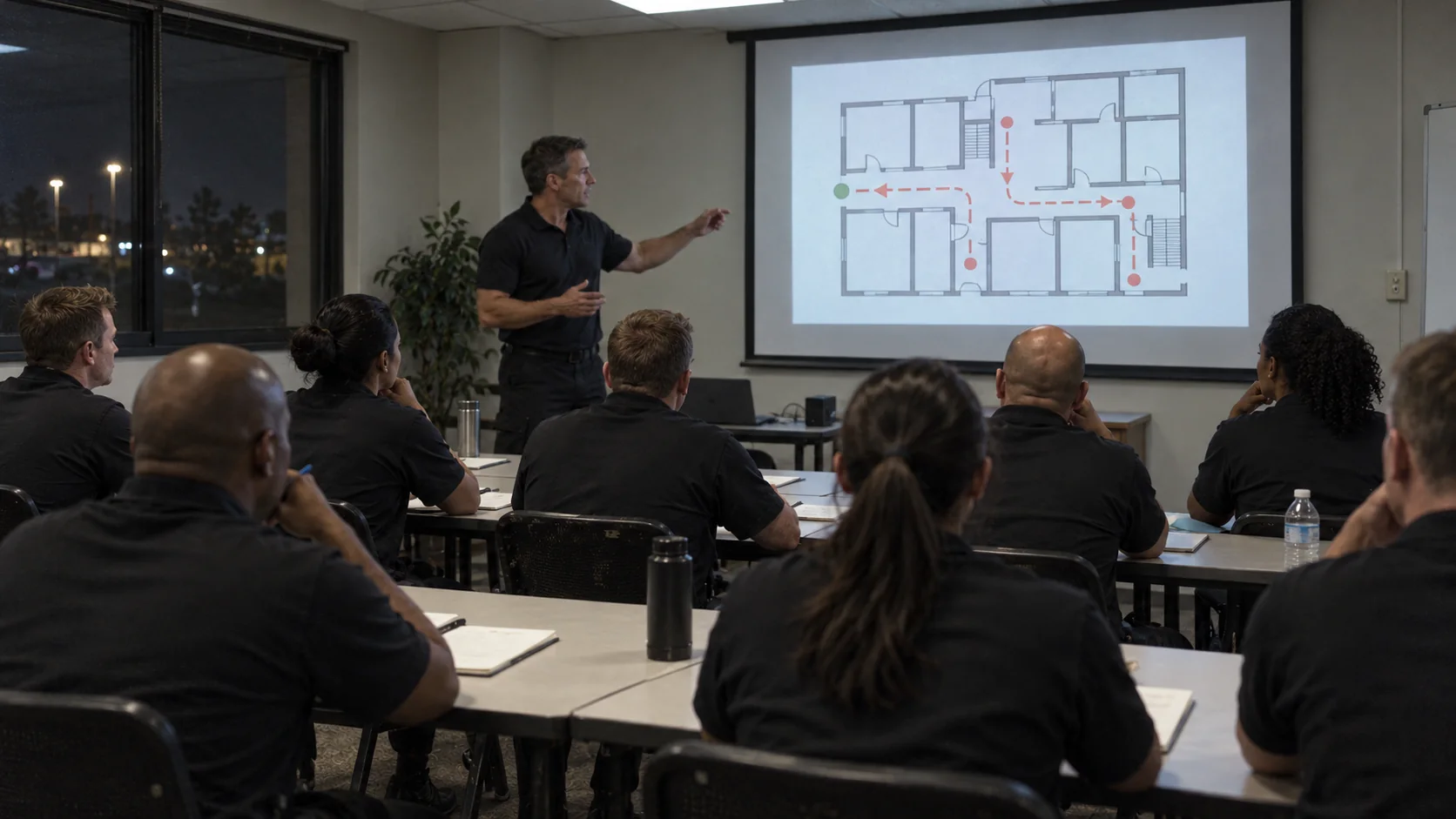
For years the initial course could be completed entirely online. Under the current structure, a portion of the training must be conducted in person, making the course a hybrid. Fully remote initial training no longer satisfies the requirement.
The full training obligation remains 40 hours: the initial 8 before licensure, then 32 additional hours of skills training completed within the first six months of employment, with defined checkpoints along the way. Annual 8-hour refresher training, including use-of-force content, continues for every registrant at renewal.
Alongside SB 652, BSIS updated registration, renewal, and certification fees under Title 16 of the California Code of Regulations, effective October 2025. Licensed companies absorbed those increases as part of compliance planning.
A security contract transfers work, not accountability. If an officer on your property turns out to be improperly trained or unregistered, the questions land on the property as well as the provider. SB 652 raised the operational bar for guard companies: recruiting pipelines now have to account for the six-month certificate window, scheduling has to account for in-person training logistics, and onboarding has to track the 32-hour completion deadlines for every new hire.
Companies that run structured onboarding and keep training records were already doing most of this. Companies that treated the guard card as a formality now have a compliance gap that a client can inherit.
Valcor Group Inc. operates under California PPO license 122608. Every officer we deploy holds an active BSIS registration, and license verification is one of the six checks in our screening process before an officer reaches a post. Training status, post-hire skills hours, and annual refreshers are tracked as part of the same documentation discipline that produces our geofenced timecards and daily activity reports. Compliance is not a marketing line here. It is a record we can show.
If you are evaluating security providers this year, ask every candidate the four questions above. The answers will tell you quickly who adjusted to the 2026 rules and who is hoping nobody asks.
Tell us about your property, your threat profile, or the scope you need covered. We respond within 24 hours on business days.
Contact ValcorOr call (424) 244-0943